Announcement
Building from Vietnam’s mathematical history
August 28, 2026 · Harry Tran
In Hanoi, we have continued surveying books and archival documents for historical preservation and research, including material we can study through our research access at the National Archives Center III. One recent example is Phạm Gia Đức, ed., and Đỗ Huy Thái's 1976 internal teaching text, Đề cương giáo trình phương pháp giảng dạy toán: Tài liệu nội bộ, produced at Trường Đại học Sư phạm Việt Bắc.
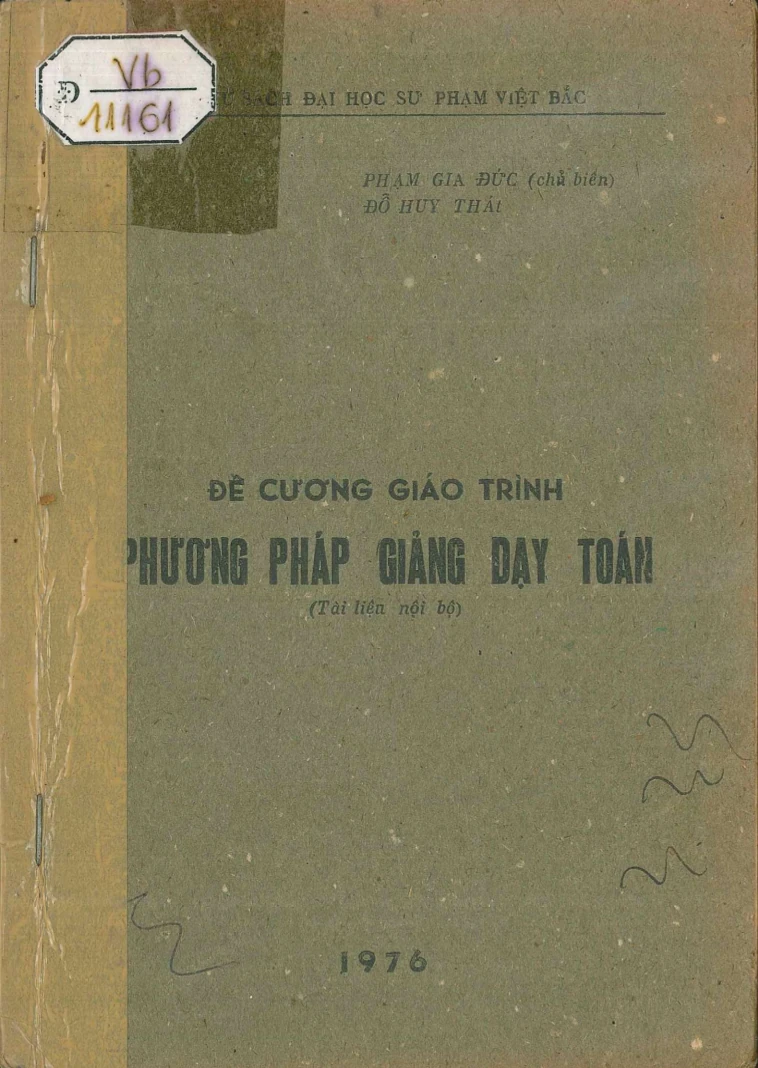
The page we scanned captures the practical challenge behind this work. Historical mathematical documents often combine faded printing, handwriting, unfamiliar notation, physical damage, and layouts that are sometimes incompatible with modern document processing.
Four parts of our work now form a flow. We preserve historical material, study the mathematics and teaching practices inside it, apply that knowledge to tools for Vietnamese students, and build evaluations that measure the mathematics those students learn.
Preserve it
Historical documents record more than mathematical content. They preserve the terminology, notation, organization, and teaching methods used in Vietnamese mathematics education at a particular time and institution. The 1976 text gives us a concrete record of how future teachers were introduced to the methods of teaching mathematics at Trường Đại học Sư phạm Việt Bắc.
Our archival work makes records like this easier to study. We survey sources, digitize pages where appropriate, annotate mathematical material, and organize each document with enough structure to support comparisons across books, institutions, and periods.
We use archival material under the procedures and permissions that govern access, copying, and reproduction. The underlying corpus will remain private and not be released to the public. VietAlpha's research access supports preservation and study. It, however, does not transfer ownership or publication rights. Our handling of the material follows archive procedures and applicable Vietnamese law, including the Law on Archives 2024 and Circular 06/2025/TT-BNV.
We can publish useful research without publishing the whole corpus. The findings, methods, and tools that emerge from this work can extend well beyond the restricted source material.
Making difficult Vietnamese documents readable
Digitization transforms a physical preservation problem into a technical question. Historical Vietnamese pages can include faded ink, handwritten notes, mathematical formulas, damaged text, and complex layouts. General-purpose document systems often lose information under those conditions.
We call our tuned specialization of PaddleOCR-VL-1.6: Sen. It is a Vietnamese-led multilingual model, tuned with a stronger mix of Vietnamese text, handwriting, and document material to improve Vietnamese document recognition while preserving the original system's broader capabilities.
Our internal evaluation shows marginal improvements in both Vietnamese and Chinese. English quality remains stable, and Sen maintains quality across the model's other supported languages. In practice, difficult Vietnamese pages become easier to read, search, and process without sacrificing the wider multilingual system.
Sen means lotus in Vietnamese, a national symbol associated with purity, resilience, and dignity. Rooted in mud, the lotus rises above the water clean and intact. The name reflects the model's purpose: recovering clear, usable text from difficult documents while preserving multilingual performance.
We plan to release Sen publicly as a tuned version of PaddleOCR-VL-1.6. We will also publish the planned mathematics benchmark and share research outputs where permissions allow. The archival corpus and our in-house mathematics model will remain private for now.
That is our approach to openness: release the tools and outputs we can share responsibly and, in good faith, abide by government regulations.
Understand it
Making a document readable is the start of the research.
Once historical mathematical material has been digitized and organized, we can examine how concepts were introduced, how terminology and notation changed, which methods teachers emphasized, and how subjects were arranged across curricula and institutions. The 1976 teaching text gives this work a clear point of reference. Its value lies in the mathematical and pedagogical choices recorded on the page.
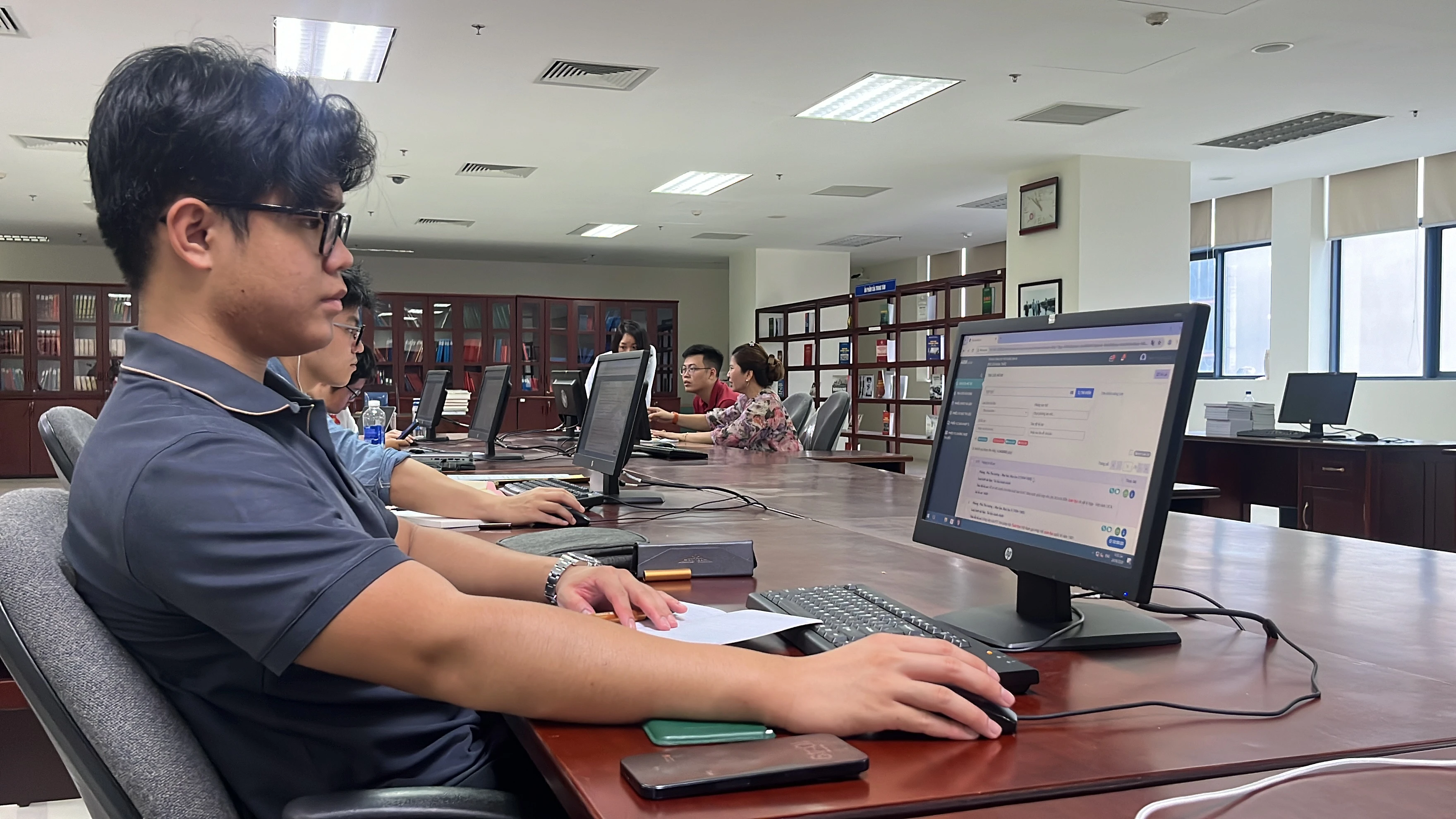
A searchable document can be compared with other textbooks, teaching materials, and archival records. Those comparisons help us trace the development of Vietnamese mathematics education across periods while preserving the differences between institutions, authors, and historical contexts.
This is how isolated books and artifacts become a usable chain of record of Vietnamese mathematical history.
Use it
The same research informs the mathematical tools we build for students now.
Vietnamese mathematics has its own language, notation, curriculum structure, and classroom conventions. Those features shape how well a model performs. A system can reason well in general and still struggle with the way a Vietnamese textbook states a geometry problem, organizes a proof, or introduces a concept.
Our in-house mathematics model has continued to improve since its initial release. The July 15 version uses Qwen3.6-35B-A3B as its base. In our current internal evaluation, its score on the mathematics category of V-bench is roughly five percentage points higher than the initial version.
The 35B-class scale keeps inference practical for us. It lowers the cost of serving the model and helps us keep LumiToán broadly available. LumiToán remains free, with generous usage limits and no paid plan.
Earlier in development, part of our objective was to beat systems such as Fable and 5.6 Sol on selected benchmarks. That chase burned time and money without advancing the goals that are most aligned with VietAlpha.
Our priorities are now tighter: strong Vietnamese mathematical capability, efficient inference, broad access through LumiToán, historical research, document recognition, and curriculum-grounded evaluation. Benchmarks serve that work when they measure useful progress.
Measure it
Current Vietnamese benchmarks do not measure high-school mathematics at the level of detail we need. Broad language evaluations can show whether a model handles Vietnamese, but they do not reveal enough about geometry, algebra, probability, calculus, multi-step reasoning, or the conventions used in Vietnamese classrooms.
We are building a Vietnamese high-school mathematics benchmark around the standard curriculum. The larger internal dataset now contains more than 14,000 items. The public release is fixed at 2,400 questions: 600 each for Grades 9, 10, 11, and 12.
We chose 2,400 public items to preserve broad coverage across grades, mathematical domains, and levels of reasoning while keeping the evaluation efficient and protecting the integrity of the larger internal pool. The result will provide more than a single undifferentiated mathematics score. It will show where a model is strong, where it fails, and whether its progress matches the curriculum Vietnamese students encounter on a daily basis.
We will publish the 2,400-item benchmark in early 2027.
If we claim that a model is improving at Vietnamese mathematics, we should measure it against Vietnamese mathematics.
Where this leaves us
We are continuing archival surveying and historical research in Hanoi, digitizing and annotating historical mathematical material, preparing Sen for public release, improving our 35B-class mathematics model, keeping LumiToán free, and building a 2,400-item Vietnamese high-school mathematics benchmark for early 2027.
The next stage is equally robust: process more historical sources, deepen the research built from them, release Sen, and publish the benchmark. Together, these projects make Vietnamese mathematical knowledge easier to preserve, easier to study, and generally available to the students and researchers who need it.